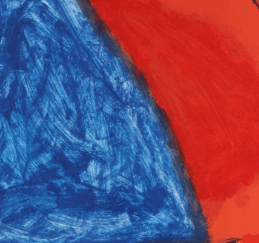
Image source: https://contemporaryartsociety.org/objects/cajun-1982 (Accessed: 25 October 2026). © The Estate of John Hoyland/DACS, London
John Hoyland, Cajun (1982), Harrogate, Mercer Art Gallery, 118.7 cm x 80.6 cm, monotype.
Harrogate’s Mercer Art Gallery is a lesser-known highlight of the busy Yorkshire art scene, playing host to a varied programme of temporary exhibitions. Its large permanent collection is typically only shown in tantalising glimpses, but from now until next September, visitors will be treated to a thorough appraisal of its extensive catalogue.[1]
What’s in Store? is neatly divided into three chronological sections, each of roughly equal size. The first section, straightforwardly titled Victorian People and Places, presents a varied range of landscapes and portraits from the 19th century. Upon entering the gallery, I’m greeted by John Atkinson Grimshaw’s Silver Moonlight (1880; figure 1).
Figure 1: https://artuk.org/discover/artworks/silver-moonlight-8899 (Accessed: 25 October 2026).
This painting was recently loaned to Leeds Art Gallery for its Grimshaw-focused exhibition, where it battled for attention with many other, equally beautiful nocturnal scenes. Here, it takes centre stage as a clear highlight, immersive and enveloping.
A child walks alone down a deserted street, which bears to the left towards an unseen vanishing point. The wet cobbles, illuminated by the dappled twilight sky, carry broken reflections of the towering, bare trees. To the right, a handsome Georgian building emits a warm, inviting glow. In the vastness of night, the child seems very small, but the overriding feeling is that all is well.
Figure 2: https://artuk.org/discover/artworks/girl-with-lovebirds-8799 (Accessed: 25 October 2026).
Figure 3: https://artuk.org/discover/artworks/cottage-interior-8435 (Accessed: 25 October 2026).
Elsewhere, romantic paintings of Byland Abbey and Knaresborough by Bernard Walter Evans ensure a local relevance, while Henry Guillaume Schlesinger’s Girl with Lovebirds (1876; figure 2) is a particularly sensitive highlight. There are more feathered subjects – pigeons this time – in Reinier Craeyvanger’s Cottage Interior (1861; figure 3); a homely scene enlivened by subtle details, like the miniature still life on the shelf near the window, and the gentle play of light on the solid wooden floor.
Figure 4: https://www.oceansbridge.com/shop/artists/t/tru-tyn/turner-joseph-mallord-william/off-st-albans-head/ (Accessed: 25 October 2026).
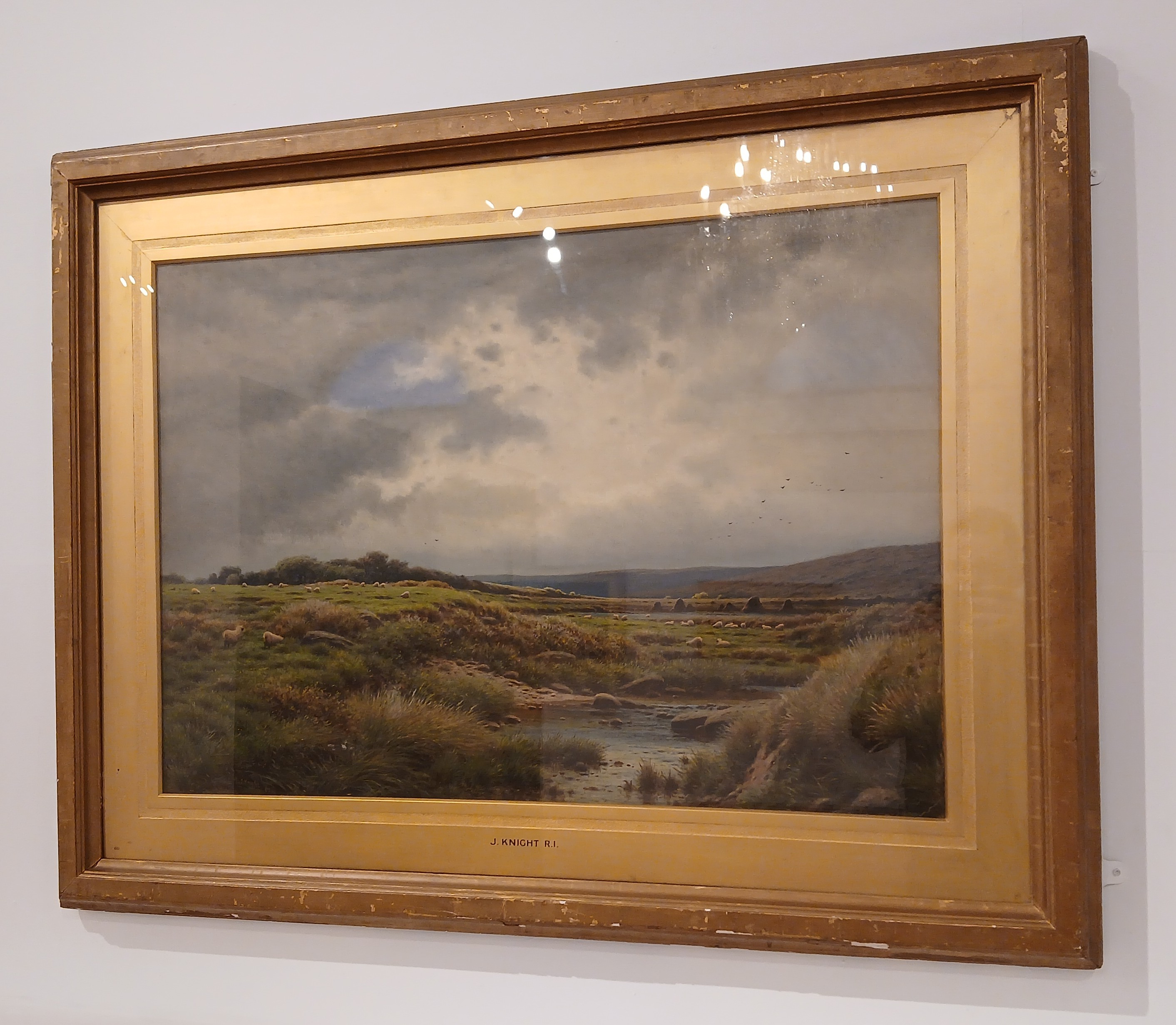
Figure 5: https://rethinkingtheimage.com/wp-content/uploads/2026/10/r049d.jpg (Accessed: 25 October 2026).
No display of Victorian paintings would be properly complete without Turner; Off St Alban’s Head (1822; figure 4) is a typically dramatic scene of high winds, swirling waves, and precarious voyages. Compare and contrast to Joseph Knight’s Landscape (1882; figure 5); gentle moorland under vast grey sky, radiating stillness.
*
The second part of the exhibition deals with modern art from 1890 to 1970, and it is here where it really comes to life, with a much broader range of works than I anticipated. Many of the names are familiar – there are works by David Bomberg, Paul Nash, John Piper, and Edward Wadsworth to name a few – allowing for a surprisingly thorough assessment of British modernism.
Figure 6: https://artuk.org/discover/artworks/tangled-pool-8430 (Accessed: 25 October 2026).
Figure 7: https://www.nationalgalleries.org/art-and-artists/15364/tidal-spaces (Accessed: 25 October 2026).
Figure 8: https://artuk.org/discover/artworks/girl-in-a-white-scarf-9026 (Accessed: 25 October 2026).
Ivon Hitchens’s Tangled Pool (1948; figure 6) and Trevor Bell’s Tidal Spaces (1958; figure 7), in which land and water are dramatically concentrated into rhythmic bursts of colour, exemplify the modern reinterpretation of traditional British landscape painting. Meanwhile, John Craxton’s Girl in a White Scarf (1949; figure 8), with its delicate fragmentation, its clever picking-out of details, and its subtle dual perspective, takes clear influence from Picasso.
Figure 9: https://contemporaryartsociety.org/objects/design-figures-1921 (Accessed: 25 October 2026).
Figure 10: https://collections.vam.ac.uk/item/O553414/the-philosopher-print-kramer/ (Accessed: 25 October 2026).
Design of Figures (1921; figure 9) is an intriguing work on paper by Wyndham Lewis, the founder of the Vorticism movement.[2] Its twisting, skewered forms are half-person, half-machine; flesh and muscle seemingly contained by angular, geometric frameworks. A comparable style informs The Philosopher (c. 1922; figure 10), a lithograph by Jacob Kramer; its studious protagonist is stylised to striking effect, his angular forms appearing almost inextricable from the books and papers in front of him.
Figure 11: https://www.osbornesamuel.com/artwork/the-spirit-of-progress/ (Accessed: 25 October 2026).
An unexpected highlight is a much smaller lithograph by war artist C. R. W. Nevinson (1933; figure 11), titled, with a certain irony, The Spirit of Progress. Its distinctive collage aesthetic reveals an unusual juxtaposition of elements – skyscrapers, warplanes, weaponry, a sculptural female torso, an artist’s easel and palette – theatrically framed by an open curtain. Industry, war, eroticism, art: a startling vision of the 20th century.
*
The third and final section brings us more or less up to date. It starts fairly strongly with a pair of figurative works by Caroline Walker, whose art is a prominent feature of the Mercer’s collection,[3] often appearing in dialogue with its temporary exhibitions. However, other figurative works fall short of the mark, and the numerous images of pools and baths (Harrogate being a historic spa town) are thoroughly predictable.
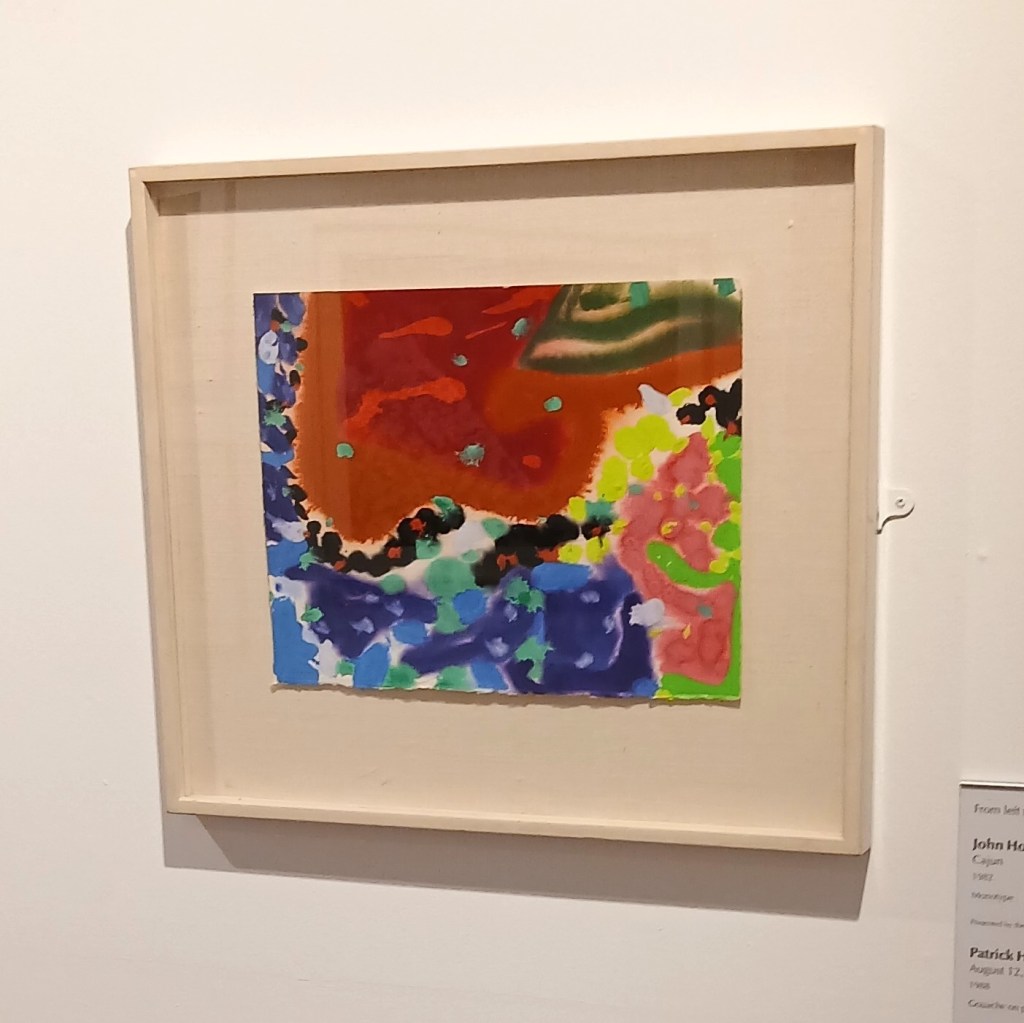
Happily, some of the best is left until last. I’m thrilled to see a late gouache by Patrick Heron, simply titled August 12, 1988 (figure 12); its lurid colours are as subtle as a poke in the eye, but somehow, Heron makes it work. It’s pure, abstract naturalism. Alongside it, John Hoyland’s Cajun (1982) makes a welcome reappearance after its inclusion in last year’s Liz West exhibition, but under the harsh light, it loses some of its potency.
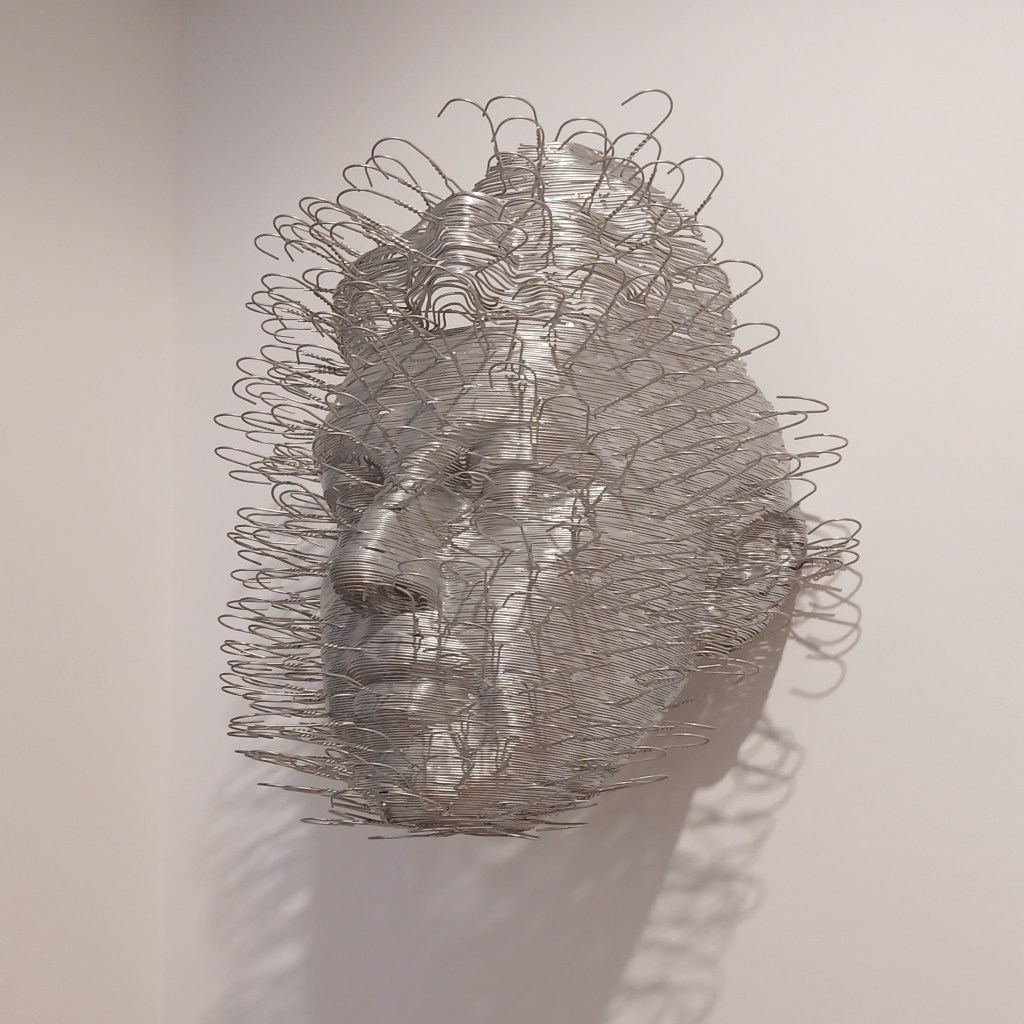
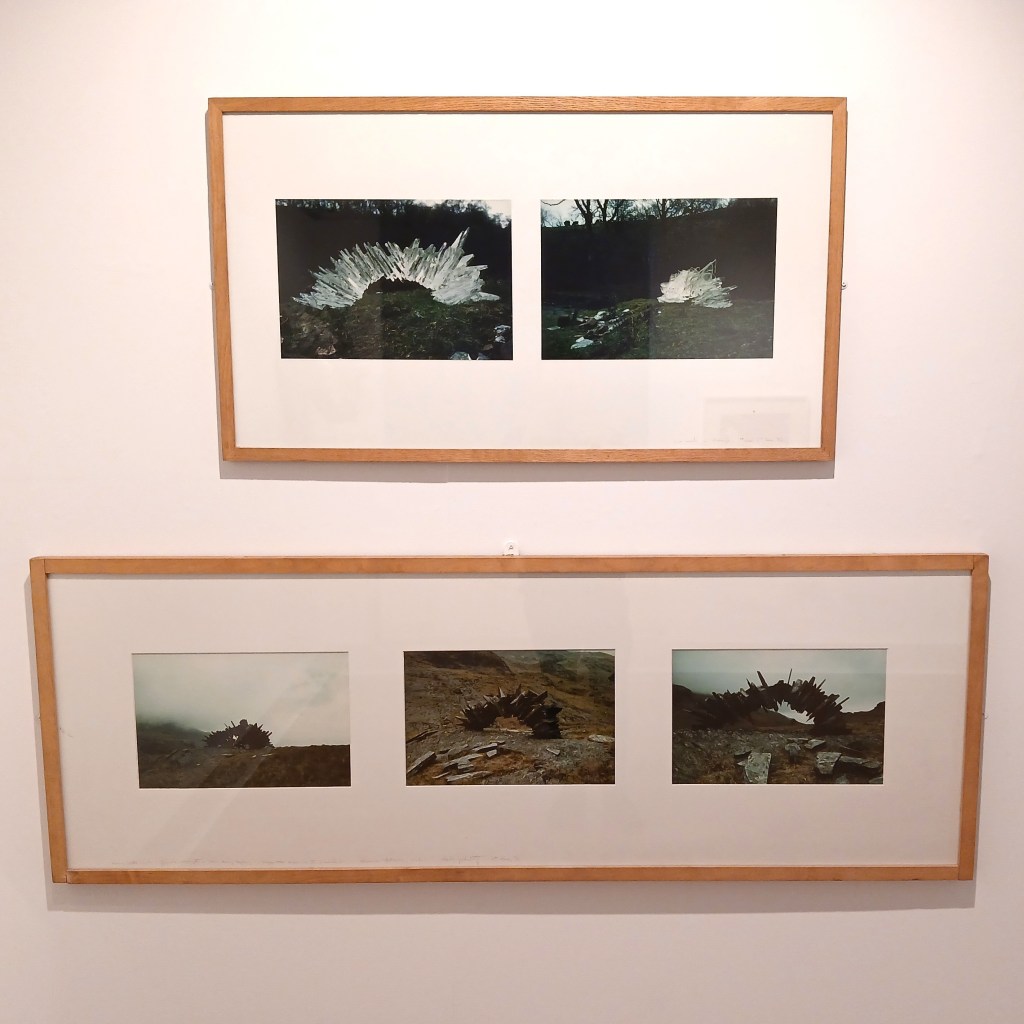
Next is David Mach’s Portrait of the Artist’s Brother (1995; figure 13). This playfully inventive work comprises hundreds of wire coat hangers, welded together around a supersized mould of the subject’s face. On an adjacent wall, a series of photographic prints serve as a record of Andy Goldsworthy’s land art pieces, Ice Arch and Slate Arch (1982; figure 14). In the end, this final section successfully demonstrates the multiplicity of artistic mediums that have flourished in parallel since 1970.
*
The title of this exhibition poses a question, inviting the viewer on a journey of discovery, and throughout its varied displays, this premise is never undermined. Accompanying labels provide essential information only, with works being loosely grouped in a non-didactic way, allowing visitors to draw their own conclusions and to form their own connections. To temper some of my earlier comments, I ought to add that some of the final section was not on display at the time of my visit – all the more reason to make a return trip to this brilliant showcase.
[1] Culture North Yorkshire (no date) What’s in Store? Available at: https://culturenorthyorkshire.co.uk/events/whats-in-store/ (Accessed: 25 October 2026).
[2] See: https://www.tate.org.uk/art/art-terms/v/vorticism (Accessed: 25 October 2026).
[3] Contemporary Art Society (no date) Suite of Works by Caroline Walker Acquired for The Mercer Art Gallery, Harrogate. Available at: https://contemporaryartsociety.org/explore/resources/suite-works-caroline-walker-acquired-mercer-art-gallery-harrogate (Accessed: 25 October 2026).


Leave a Reply