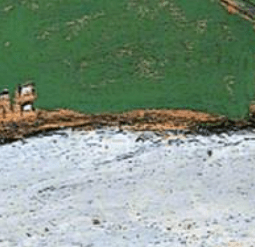
Image source: https://artuk.org/discover/artworks/mounts-bay-with-st-michaels-mount-cornwall-38612 (Accessed: 17 May 2026). © Bridgeman Images
Alfred Wallis, Mount’s Bay with St Michael’s Mount, Cornwall (c. 1928-42), Leeds Art Gallery, 28 cm x 40 cm, oil and crayon on cardboard.
Alfred Wallis began to paint at the age of seventy, as a way to deal with his loneliness in the wake of his wife’s death.[1] A few short years later, in 1928, a chance encounter with prominent artists Christopher Wood and Ben Nicholson would come to define his creative reputation, leading this untrained painter from humble beginnings to be unexpectedly embraced by Britain’s artistic elite.[2]
Born in Devonport in 1855, Wallis grew up in extreme poverty, losing a large part of his family to disease.[3] He worked at sea as a cabin boy at the age of ten; as a teenager, he returned to his father’s hometown of Penzance, where he worked as a fisherman.[3] In 1882 he moved to St Ives[3] – already an important artistic hub – where he worked a number of jobs, including running a marine store and selling ice cream.[2]
Wallis’s paintings, informed by a lifetime of living and working by the sea, depict coastal townscapes and nautical scenes. Typically painted on scraps of wood and cardboard,[2] they are characterised by their naïve, almost childlike visual language, whereby complex scenes are concentrated, via a limited colour palette, into heavily simplified forms.[4]
In 1928, Nicholson and Wood were holidaying in St Ives when they happened upon Wallis’s work.[2] The two artists bought a number of his paintings, and on their return to London, they encouraged their peers to do the same; Wallis’s paintings seemed to exemplify, in a particularly uninhibited and uncontrived manner, the growing tendency towards abstraction in British art.[2] In the years and decades that followed, his work would be purchased by artists such as Barbara Hepworth, Henry Moore, and Patrick Heron, as well as the director of the Tate gallery, Jim Ede.[2]
Mount’s Bay with St Michael’s Mount adopts a flattened, almost cartographic perspective, as seen in other works by Wallis such as Houses at St Ives (c. 1928-33)[5] and Two Boats Moving Past a Big House (c. 1932-37).[6] While this approach does clearly not lend itself to realistic depiction, it nonetheless allows Wallis to concisely convey the geographical positioning of key elements within the scene.
The support – an irregular-shaped piece of scrap cardboard – serves as an integral part of the work. The unpainted sections comprise the harbour and its connecting roads and pathways, forming a set of spatial boundaries which delineate fields and buildings, and which separate sea from land.
The sea, thickly textured to give the impression of swelling movement, exists in clear opposition to the solid, static appearance of the harbour and its surrounding landscape. Two sailing boats, plainly rendered in black, venture out onto the open water – perhaps tentatively, perhaps assuredly. What the work may lack in realism, it more than makes up for with its rustic charm.
[1] Art UK (no date) Alfred Wallis. Available at: https://artuk.org/discover/artists/wallis-alfred-18551942 (Accessed: 17 May 2026).
[2] Savage, R. (2019) An Unexpected Success: Alfred Wallis and the World of British Art. Available at: https://artuk.org/discover/stories/an-unexpected-success-alfred-wallis-and-the-world-of-british-art (Accessed: 17 May 2026).
[3] Alfred Wallis (no date) About Alfred Wallis. Available at: https://www.alfredwallis.co.uk/about-alfred-wallis (Accessed: 17 May 2026).
[4] See: https://artuk.org/discover/artworks/search/actor:wallis-alfred-18551942 (Accessed: 17 May 2026).
[5] See: https://www.tate.org.uk/art/artworks/wallis-houses-at-st-ives-cornwall-t00239 (Accessed: 17 May 2026).
[6] See: https://artuk.org/discover/artworks/two-boats-moving-past-a-big-house-139762 (Accessed: 17 May 2026).


Leave a Reply