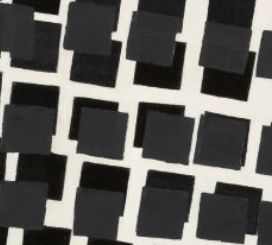
Image source: https://www.barns-grahamtrust.org.uk/things-of-a-kind-in-order-and-disorder/ (Accessed: 12 April 2026). © Wilhelmina Barns-Graham Trust
Wilhelmina Barns-Graham, Progression (1965), Leeds Art Gallery, 197.5 cm x 121.5 cm, oil on board.
See also: https://www.tate.org.uk/art/artworks/clough-by-the-canal-t02093 (Accessed: 12 April 2026).
Prunella Clough, By the Canal (1976), London, Tate Britain, 182.9 cm x 142.2 cm, oil on canvas.
Late last year, while wandering through the upper floor of Leeds Art Gallery, I spotted a large abstract painting consisting entirely of black squares on a white background; it was a work that I’d probably passed many times before, but which had completely escaped my attention. I moved in to take a closer look, and my interest was suddenly piqued when I saw that the painting I was looking at was Progression (1965) by Wilhelmina Barns-Graham.
Barns-Graham’s work is well-represented in Yorkshire’s galleries, my introduction to her long and brilliant career being Orange Form (1957),[1] which I first saw at York Art Gallery back in 2024. Several months later, I saw Three Rocks (1952)[2] at Leeds Art Gallery; I would discuss both paintings in a July 2025 instalment of Art in Focus. More recently, I saw an early abstract work by the artist at the Stanley & Audrey Burton Gallery.
Progression (1965) comes from Barns-Graham’s ‘Order and Disorder’ series – a body of work, produced mainly in the 1960s and early 1970s, which focuses on the displacement of simple geometric forms.[3][4] For some of the early paintings in the series, the artist began by neatly laying painted cards on the floor and moving them with her foot, carefully studying and recording the resulting configurations.[3]
In 1915 – when Barns-Graham was three years old – the pioneering Kazimir Malevich painted a single, static black square on a white background to symbolise a new, non-representational approach to art.[5] Half a century later, Barns-Graham painted lots of black squares – too many to count, in fact – leaping and cascading across a large white surface, representing the crescendo of her own journey from rugged depictions of nature to striking abstraction.
Far from being completely divorced from reality, however, the arrangement of these squares evokes the rhythms of the natural world while serving as an indelible record of the artist’s motions. In the top-left of the painting, the squares are densely packed together; in the centre of the work, they spread out to form new patterns and symmetries before coming back together in the bottom-right, where order is restored.
Barns-Graham would often use her painted cards to apply pigment to the canvas or board itself; as the card was pulled away from the support, it would leave a raised texture.[3] This technique is particularly apparent in Progression, where the top layer of squares appears in a slighter lighter hue, creating an increased sense of depth.
*
Prunella Clough’s artistic career coincided closely with that of Barns-Graham, but while the St Ives artist drew endless inspiration from the natural world, Clough’s fascinations were to be found in the industrial, urban environment and its varied detritus.[6] Her diagrammatic paintings highlight the peripheral and the obscure; fences, slag heaps, cooling towers, industrial waste, and heavy machinery are distilled and distorted through the process of looking.[7]
At first glance, By the Canal (1976) appears to be an abstract colour field painting. A steely blue background is overlaid with a copper-coloured geometric form; the two colours leak into each other, forming a coherent whole. It is only when we come closer to the painting’s surface that we notice the series of delicate vertical lines which border the top edge of the copper-coloured form, resembling barbed wire.
This detail, along with the painting’s title, effectively transforms it – in the eyes of the viewer – from an abstract work into something which relates much more closely to external reality; we now see an oxidised iron gate or canal lock, holding back the icy depths. Now that we are close to the painting, it begins to imply a scale which transcends its physical dimensions, echoing the intimidating effect of large bodies of water and industrial infrastructure.
As women artists, Wilhelmina Barns-Graham and Prunella Clough carved out highly successful artistic careers at a time when British art was very much a male-dominated sphere. Perhaps even more significantly, they both established unique visual identities – Barns-Graham with her playful, naturalistic compositions of shape, and Clough with her harsh, gritty reconstructions of industrial scenes – which prompt us to reconsider our understanding of abstraction and representation.
[1] Art UK (no date) Orange Form. Available at: https://artuk.org/discover/artworks/orange-form-8461 (Accessed: 12 April 2026).
[2] Art UK (no date) Three Rocks. Available at: https://artuk.org/discover/artworks/three-rocks-37983 (Accessed: 12 April 2026).
[3] Bertram, G. (2020) Things of a Kind in Order and Disorder. Available at: https://www.barns-grahamtrust.org.uk/things-of-a-kind-in-order-and-disorder/ (Accessed: 12 April 2026).
[4] Wilhelmina Barns-Graham Trust (no date) Theme: Things of a Kind in Order & Disorder. Available at: https://wbg.emuseum.com/view/objects/asimages/9400?t:state:flow=5140672c-e654-4fe7-b940-28fe4ac86976 (Accessed: 12 April 2026).
[5] Tate (no date) Five Ways to Look at Malevich’s Black Square. Available at: https://www.tate.org.uk/art/artists/kazimir-malevich-1561/five-ways-look-malevichs-black-square (Accessed: 12 April 2026).
[6] Tate (no date) Prunella Clough: Urbscapes. Available at: https://www.tate.org.uk/visit/tate-britain/display/modern-and-contemporary-british-art/prunella-clough-urbscapes (Accessed: 12 April 2026).
[7] Art UK (no date) Prunella Clough. Available at: https://artuk.org/discover/artworks/search/actor:clough-prunella-19191999 (Accessed: 12 April 2026).
 Rethinking the Image
Leave a comment