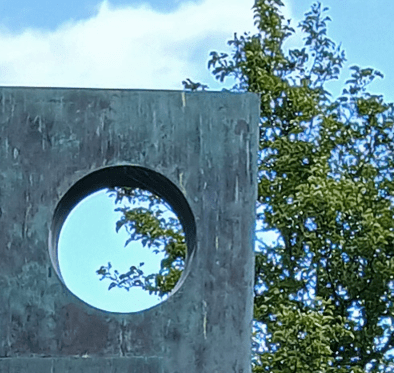
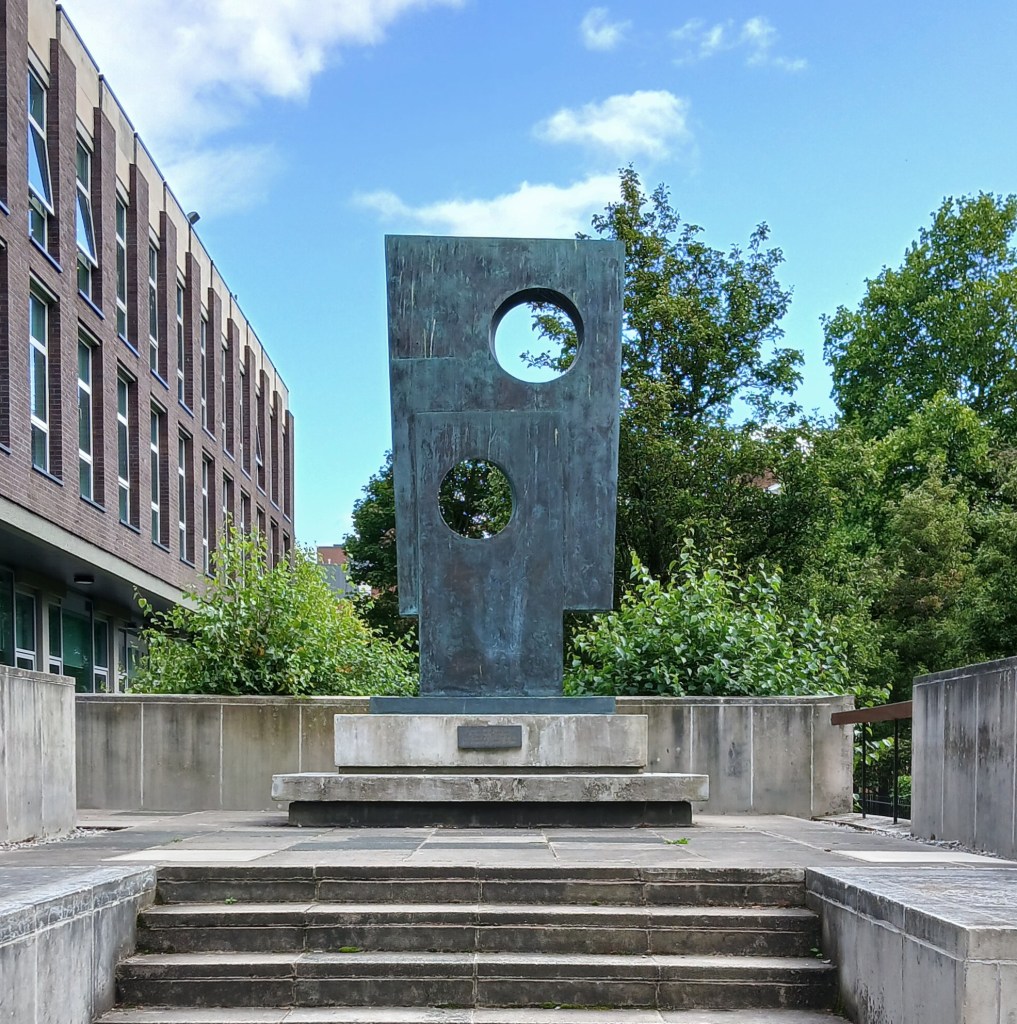
Dame Barbara Hepworth, Squares with Two Circles (1963), Bronze, University of Liverpool, 306.1 cm x 137.2 cm x 31.8 cm. © Bowness
See also: https://www.tate.org.uk/art/artworks/hepworth-squares-with-two-circles-t00702 (Accessed: 18 January 2026).
Barbara Hepworth was a key figure in the development of abstract art in Britain; today, her name remains synonymous with Modernist sculpture. Her work can be seen in galleries and sculpture gardens around the world; in the UK, it can also be found in many public places, including several university campuses.
Born in Wakefield, Hepworth moved to Cornwall in 1939 with her husband, the artist Ben Nicholson.[1] Hepworth’s obituary in the Guardian newspaper in 1975 posited that she was the most significant woman artist in history,[2] and today, her legacy is preserved by both the Hepworth Wakefield art gallery, located in the city of her birth, and the Barbara Hepworth Museum and Sculpture Garden in St Ives.
Squares with Two Circles is a towering bronze monolith, whose overlapping polygons are punctuated by two circular holes – a configuration which echoes Ben Nicholson’s ‘reliefs’ of the 1930s.[3] Its lightly pitted surface gives the impression of weathering, while its two circular apertures serve as windows to the world beyond.
As a work of art, it is therefore unusual in that it does not draw attention to itself, but rather, to its own environs, encouraging the viewer to take a closer look at whatever it makes visible. This is all by design, of course – Hepworth, always keen for her large-scale sculptures to be experienced outdoors, placed the two apertures ‘in relation to human vision’.[4][5]
This particular cast of Squares with Two Circles is numbered ‘0/3’.[6][7] It was purchased by the University of Liverpool in 1967, and for many years it resided outside the Sydney Jones Library, on a plinth which had been specially designed by the artist.[6] In 2014 it was moved to a new location, just behind the newly-completed Crown Place accommodation complex;[6] a few years later, as a first-year undergraduate, I would look out at the sculpture from my kitchen window.
On my most recent visit to Liverpool, I was pleased to see that the sculpture had since been returned to its original location. To the left, the Sydney Jones Library is a fine example of modernist architecture with some prominent brutalist touches, while to the right, the Abercromby Square gardens bestow the campus with a touch of nature. It is in this environment that Squares with Two Circles, with its blend of geometric and organic forms, seems thoroughly at home.
The constructed world is characterised by quadrilaterals, while in the natural world, the circle is ubiquitous. Positioned directly between these two worlds while also embodying them, Squares with Two Circles acts as their mediator, its apertures providing intriguing glimpses of their respective aesthetic qualities.
[1] Gale, M. (1997) Dame Barbara Hepworth. Available at: https://www.tate.org.uk/art/artists/dame-barbara-hepworth-1274 (Accessed: 18 January 2026).
[2] Art UK (no date) Barbara Hepworth. Available at: https://artuk.org/discover/artists/hepworth-barbara-19031975 (Accessed: 18 January 2026).
[3] Tate (no date) 1935 (white relief). Available at: https://www.tate.org.uk/art/artworks/nicholson-1935-white-relief-t00049 (Accessed: 18 January 2026).
[4] Yorkshire Sculpture Park (no date) Barbara Hepworth: Squares with Two Circles. Available at: https://ysp.org.uk/art-outdoors/squares-with-two-circles (Accessed: 18 January 2026).
[5] Gale, M. (1998) Squares with Two Circles. Available at: https://www.tate.org.uk/art/artworks/hepworth-squares-with-two-circles-t00702 (Accessed: 18 January 2026).
[6] Draper, A. (2023) Moving Big Stuff: the Barbara Hepworth Sculpture. Available at: https://vgm.liverpool.ac.uk/blog/2023/moving-big-stuff-the-barbara-hepworth-sculpture/ (Accessed: 18 January 2026).
[7] The other three casts of Squares with Two Circles can be seen at the Yorkshire Sculpture Park, the Kröller-Müller Museum in the Netherlands, and the Nasher Sculpture Centre in Texas.
 Rethinking the Image
Leave a comment