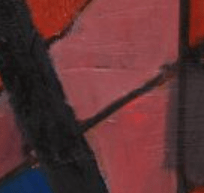
Image source: https://www.barns-grahamtrust.org.uk/abstract-issue-4/ (Accessed: 9 November 2025). © Wilhelmina Barns-Graham Trust
Wilhelmina Barns-Graham, Untitled (c. 1957), Leeds, The Stanley & Audrey Burton Gallery, 45.4 cm x 68.1 cm, oil on canvas.
I recently made my first visit to the Stanley & Audrey Burton Gallery, located within the Parkinson Building at the University of Leeds. With its prominent clock tower, the building is among the city’s most recognisable landmarks, but its gallery is something of a hidden gem, making excellent use of its limited space to display a wide range of British and European art.
Among its displays, an abstract painting by Wilhelmina Barns-Graham, presented in a thick black frame, cuts a powerful presence. Barns-Graham, who I introduced in a previous instalment of Art in Focus, had a long and prolific career which evidenced a rigorous examination of colour and shape.[1]
Untitled (c. 1957) is an example of the artist’s early forays into non-representational painting,[1] likely completed while she was teaching at Leeds College of Art.[2] In this painting, panels of colour – blues, greens, purples, mauves and oranges – are demarcated by a complex network of diagonal and horizontal lines, arranged across an earthy background.
Once the painting’s key elements have been registered, its subtle complexities begin to show themselves. Rather than comprising a single, solid hue, the background is a patchwork of subtly different reds and oranges which seeps through some of the lighter-coloured panels; in turn, the background itself occasionally gives way to a much darker underlayer. Elsewhere, there are slight overlaps between areas of colour.
These inconsistencies create a sense of depth and a potential for illusion; some colours appear to be regressing into the background, some appear neatly constricted by the network of lines, and others appear to float above them, rising to the surface.
The most vital element of the painting is the thick line at its centre, which serves as its focal point and visual anchor, while the thinner lines provide further structure to its composition. Here, Barns-Graham’s prominent use of diagonal lines foreshadows the dynamic ‘Scorpio Series’ paintings of her later years, which traded the static precision of earlier works for a sense of unbridled spontaneity.[3][4]
Historically underappreciated, Barns-Graham is recognised today as one of the most important figures in 20th-century British art. Next year, her career will be charted in detail as part of a major retrospective exhibition at the Tate St Ives, bringing together over 170 of her works.[5]
[1] Wilhelmina Barns-Graham Trust (no date) Collections. Available at: https://wbg.emuseum.com/collections (Accessed: 9 November 2025).
[2] Wilhelmina Barns-Graham Trust (no date) Abstract, Issue 4. Available at: https://www.barns-grahamtrust.org.uk/abstract-issue-4/ (Accessed: 9 November 2025).
[3] Bertram, G. (2020) The Scorpio Series. Available at: https://www.barns-grahamtrust.org.uk/the-scorpio-series/ (Accessed: 9 November 2025).
[4] Wilhelmina Barns-Graham Trust (no date) Theme: Scorpio. Available at: https://wbg.emuseum.com/view/objects/asimages/9399?t:state:flow=c97c2a32-ecaa-4d34-9aac-5bb293465bc0 (Accessed: 9 November 2025).
[5] Tate (no date) Wilhelmina Barns-Graham. Available at: https://www.tate.org.uk/whats-on/tate-st-ives/wilhelmina-barns-graham (Accessed: 9 November 2025).
 Rethinking the Image
Leave a comment