
Image source: https://rethinkingtheimage.com/wp-content/uploads/2026/02/r027.png (Accessed: 20 February 2026). © ADAGP, Paris
From Maspero, F. (1990), Les Passagers du Roissy-Express. Paris: Éditions du Seuil, p. 58. (Photograph by Anaïk Frantz).
In May 1989, writer François Maspero and photographer Anaïk Frantz embarked on an unusual expedition. Over the course of a month, they travelled on the RER B line[1] from Paris Charles de Gaulle Airport to the line’s terminus at St Rémy-lès-Chevreuse, traversing the French capital and its peripheral areas.[2] Their words and photographs would form the critically acclaimed travelogue, Les Passagers du Roissy-Express.
Their itinerary took in many areas not frequented by visitors, including many of the banlieues – neighbourhoods of low-income, high-density housing which, through failures in urban planning, were acquiring an unwelcome reputation for poverty, joblessness, and crime.[3] Maspero and Frantz surveyed these areas with thoughtful curiosity, diligently recording their particular quirks and characteristics.
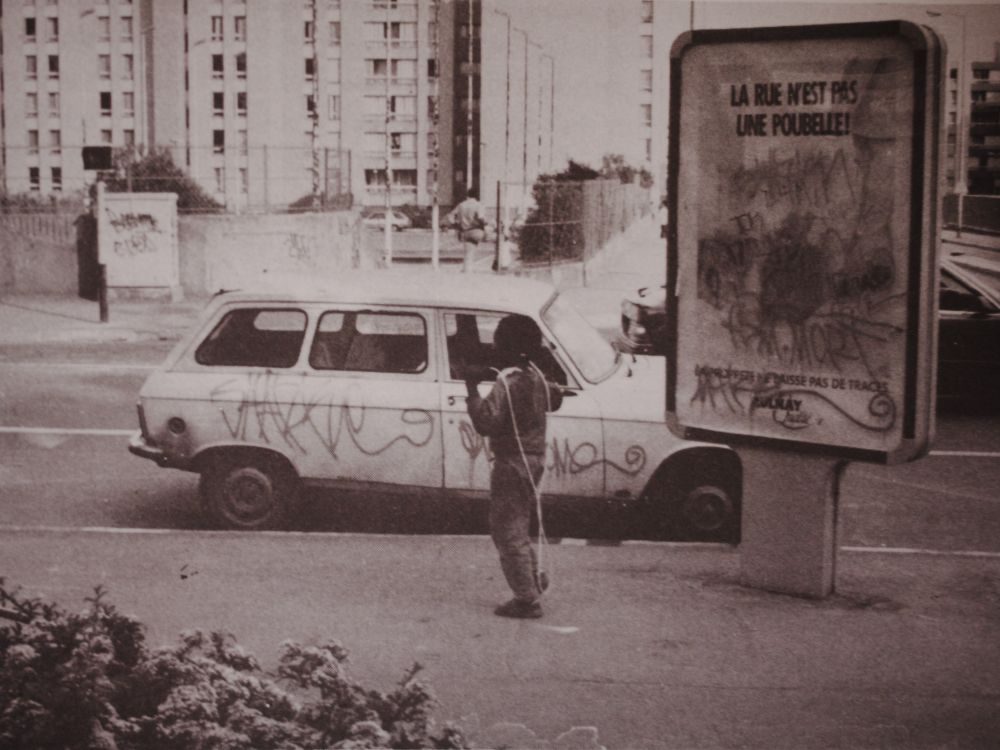
Taken in the commune of Villepinte, located in the north-eastern suburbs of Paris, this image is one of the many candid photographs by Frantz which appear alongside Maspero’s words. Here, a young boy plays on the pavement with a skipping rope, near a group of tower blocks, in what could be considered an archetypal banlieue scene – a vision of ordinary life in unsympathetic surroundings.
The viewer’s attention is immediately drawn, however, to the unusual sight of a graffiti-covered car – presumably abandoned – in the middle ground of the image. Directly in front of the car, a billboard sprouts inelegantly from the pavement to deliver the phrase ‘La rue n’est pas une poubelle’; roughly translating as ‘This street isn’t a litter bin’, this refrain of French public service advertising could be said to possess a somewhat accusatory tone.
The billboard is covered in graffiti tags, consistent in style with those on the car. The word mort (‘dead’) can be clearly identified, but they are otherwise illegible, with any relation to the advertisement itself being a matter of speculation. However, it seems likely that the defacer of the billboard was seeking to subjugate its reproachful slogan.
The street appears perfectly clean, suggesting that the billboard’s message has either served its purpose or is unnecessary. What is interesting is that, while the street is not being used as a receptacle for litter, it is clearly being utilised for at least two activities outside of its intended purposes, serving as both a playground for the child and as a blank canvas for the unidentified vandal.
[1] The Réseau Express Régional (RER) is a rail system which serves Paris and its suburbs. Line B runs north-east to south-west, connecting Paris Charles de Gaulle Airport to the commune of St Rémy-lès-Chevreuse via the centre of the city.
[2] Maspero, F. (1990) Les Passagers du Roissy-Express. Paris: Éditions du Seuil.
[3] Angélil, M. and Siress, C. (2012) ‘The Paris Banlieue: Peripheries of Inequity’, Journal of International Affairs, 65(2), p. 57.
 Rethinking the Image
Leave a comment