
Image: https://www.thedoublenegative.co.uk/blog/wp-content/uploads/2025/05/Allthatremainslarge-431×640.jpg from https://www.thedoublenegative.co.uk/2025/06/all-that-remains-a-curators-choice-reviewed/ (Accessed: 20 February 2026).
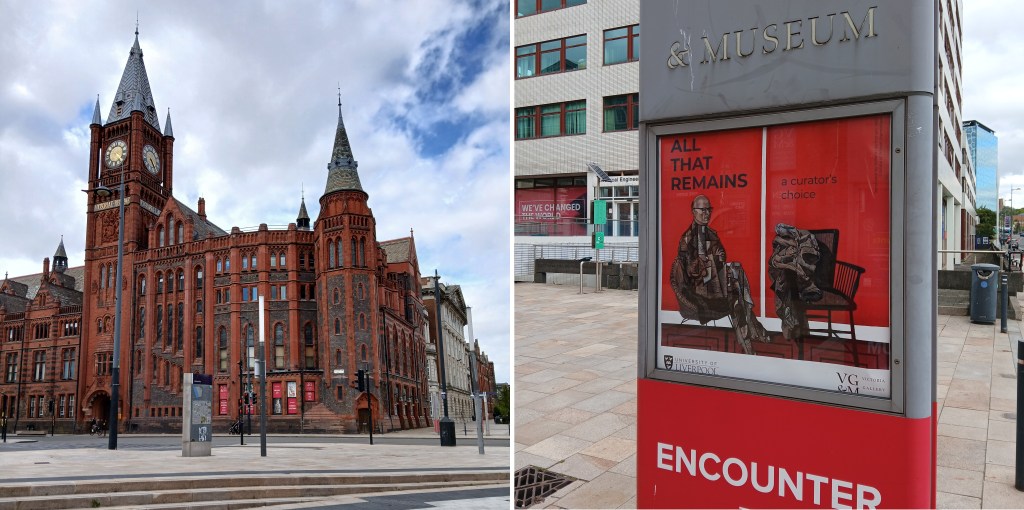
William Utermohlen, Trenchcoat (1968), Liverpool, Victoria Gallery & Museum, 118 cm x 76 cm, oil on canvas.
William Utermohlen was an American figurative artist who lived and worked in London for much of his life.[1] He is best known for his troubling late self-portraits, which chronicled his physical and mental deterioration in the years following his diagnosis of Alzheimer’s disease in 1995;[1][2] less well known is the long and varied career that preceded them.
Currently on display at the University of Liverpool’s Victoria Gallery & Museum is an exhibition titled All That Remains: A Curator’s Choice. Curated by the departing Dr Amanda Draper, it brings together works from the collection that have not previously been displayed during her tenure – among them, Utermohlen’s Trenchcoat is on public view for the first time in over twenty years,[3] featuring prominently in the exhibition’s promotion.
Upon viewing Trenchcoat for the first time, I’m immediately struck by the stunning brightness of its distinctive red background, which calls to me from across the gallery. The background is bisected by a vertical white stripe, forming two separate panels; on the left is the sitter – a Cuban writer named Juan Arocha – while to the right, a trenchcoat lies discarded on an empty chair in reference to the artist himself.[3]
The figure’s head and hands are rendered in a pleasing realist style, but the rest of his silhouette is infilled with a cubist configuration of shapes which bears particular resemblance to the analytical cubism of Georges Braque, as seen in works such as The Candlestick (1911).[4] Here, the French artist’s cubist style is appropriated not only for aesthetic purposes, but also to represent Arocha’s French citizenship.[5]
As is typical of analytical cubism, the result is less abstract than it initially appears, with the sitter’s pose being subtly communicated through the contours and edges of these geometric forms. Utermohlen’s attention to detail is equally evident elsewhere in the painting, such as in the weave of the sitter’s basket chair, the pattern of the blanket that adorns it, and the intricate folds of the discarded trenchcoat.
I’m hopeful that Trenchcoat will be displayed again in the not-too-distant future, especially given the interest that it seemed to attract during my visit to the gallery. After all, this striking work shows Utermohlen at the height of his skill and creativity, which is surely how he would want to be remembered.
[1] William Utermohlen (no date) About. Available at: https://www.williamutermohlen.com/about (Accessed: 20 February 2026).
[2] William Utermohlen (no date) 1991-2000 Late Self Portraits. Available at: https://www.williamutermohlen.com/1991-2000-late-self-portraits (Accessed: 20 February 2026).
[3] All That Remains: A Curator’s Choice (2025). [Exhibition]. Victoria Gallery & Museum. 17 May-20 September.
[4] National Galleries of Scotland (no date) Le Bougeoir [The Candlestick]. Available at: https://www.nationalgalleries.org/art-and-artists/420 (Accessed: 20 February 2026).
[5] Art In Its Time (2021) Art In Its Time: William Utermohlen. 17 January. Available at: https://www.youtube.com/watch?v=TIoGFVdtRUI&t=1649s (Accessed: 20 February 2026).
 Rethinking the Image

Leave a comment