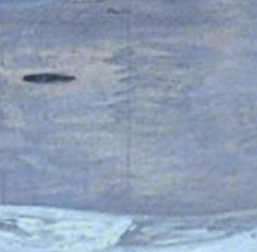
Image source: https://artuk.org/discover/artworks/three-rocks-37983 (Accessed: 20 February 2026). © Wilhelmina Barns-Graham Trust
Wilhelmina Barns-Graham, Three Rocks (1952), Leeds Art Gallery, 61.6 cm x 106.7 cm, oil on canvas.
See also: https://artuk.org/discover/artworks/orange-form-8461 (Accessed: 20 February 2026).
Wilhelmina Barns-Graham, Orange Form (1957), York Art Gallery, 50.8 cm x 76.1 cm, oil on canvas.
In the last instalment of Art in Focus, I introduced Patrick Heron, whose ‘wobbly, hard-edge’ paintings frequently refer to the coastal geography of Cornwall.[1] Today’s article examines two paintings by Wilhelmina Barns-Graham, another prominent figure within the St Ives School of artists for whom the rugged Cornish landscape was equally inspiring.[2][3]
Barns-Graham’s exceptionally long career evidenced many different styles and approaches.[2][4] Over its course, landscapes and vistas were concentrated into their most essential forms, resulting in a precise, hard-edged form of abstraction which, in her later years, would ultimately give way to rhythmic, spontaneous celebrations of life and colour.[4]
Three Rocks is semi-abstract and largely two-dimensional, with its angular, geometric forms recalling the cliffs and rock formations of the Cornish coastline. These forms are dark and brooding, and although the painting’s ambiguous perspective denies the viewer a clear sense of scale, their verticality is suggestive of their monumental size.
Patches of blue and grey, recalling the ocean, the sky, and the changing tide, make up the remainder of the painting. These elements are not separate from the three rocks, but rather, are part of an arrangement of interlocking forms which put forward a stylised concentration of a coastal panorama, evoking the power and formidable beauty of nature.
Completed some five years later, Orange Form sets an eye-catching, dark orange quadrilateral against a plane of overlapping shapes – some dark, others light; some simple, others complex. The result is undoubtedly more abstract than Three Rocks, but when the form is viewed in combination with the two thick lines which sprout from underneath it like a pair of legs, its resemblance to an artist’s easel is hard to ignore.
The top and bottom sides of the orange form are non-parallel, lending the image a prominent three-dimensional quality. The perspective from which we see the form is explained by the three-pronged, pincer-like shape to its left, which appears to playfully grasp at the form as it rises up from the flat surface – a reading which is reinforced by its accompanying shadow.
While Three Rocks draws on Barns-Graham’s early representational work, Orange Form demonstrates her development as an abstract artist.[4] However, despite this fundamental difference between the two works, they both evidence her highly nuanced understanding of geometry and shape.
[1] Gayford, M. (2021) Patrick Heron: The Colour of Colour. [Exhibition catalogue]. London: Hazlitt Holland-Hibbert, p. 15.
[2] Wilhelmina Barns-Graham Trust (no date) Wilhelmina Barns-Graham. Available at: https://www.barns-grahamtrust.org.uk/ (Accessed: 20 February 2026).
[3] Wilhelmina Barns-Graham Trust (no date) Views. Available at: https://www.barns-grahamtrust.org.uk/eight-decades-of-artistic-practice/views/ (Accessed: 20 February 2026).
[4] Art UK (no date) Wilhelmina Barns-Graham. Available at: https://artuk.org/discover/artworks/search/actor:barns-graham-wilhelmina-19122004/sort_by/date_earliest/order/asc/page/1/view_as/grid (Accessed: 20 February 2026).
 Rethinking the Image
Leave a comment