Image source: https://www.bridgemanimages.com/en/heron/complex-carmines-and-cadmiums-with-brown-luminous-disc-may-1968/gouache-on-paper/asset/108816?offline=1 (Accessed: 1 October 2025). © Leeds Museums and Galleries/Bridgeman Images
See also: https://rethinkingtheimage.com/wp-content/uploads/2026/02/2025-05-2.jpg (Accessed: 20 February 2026).
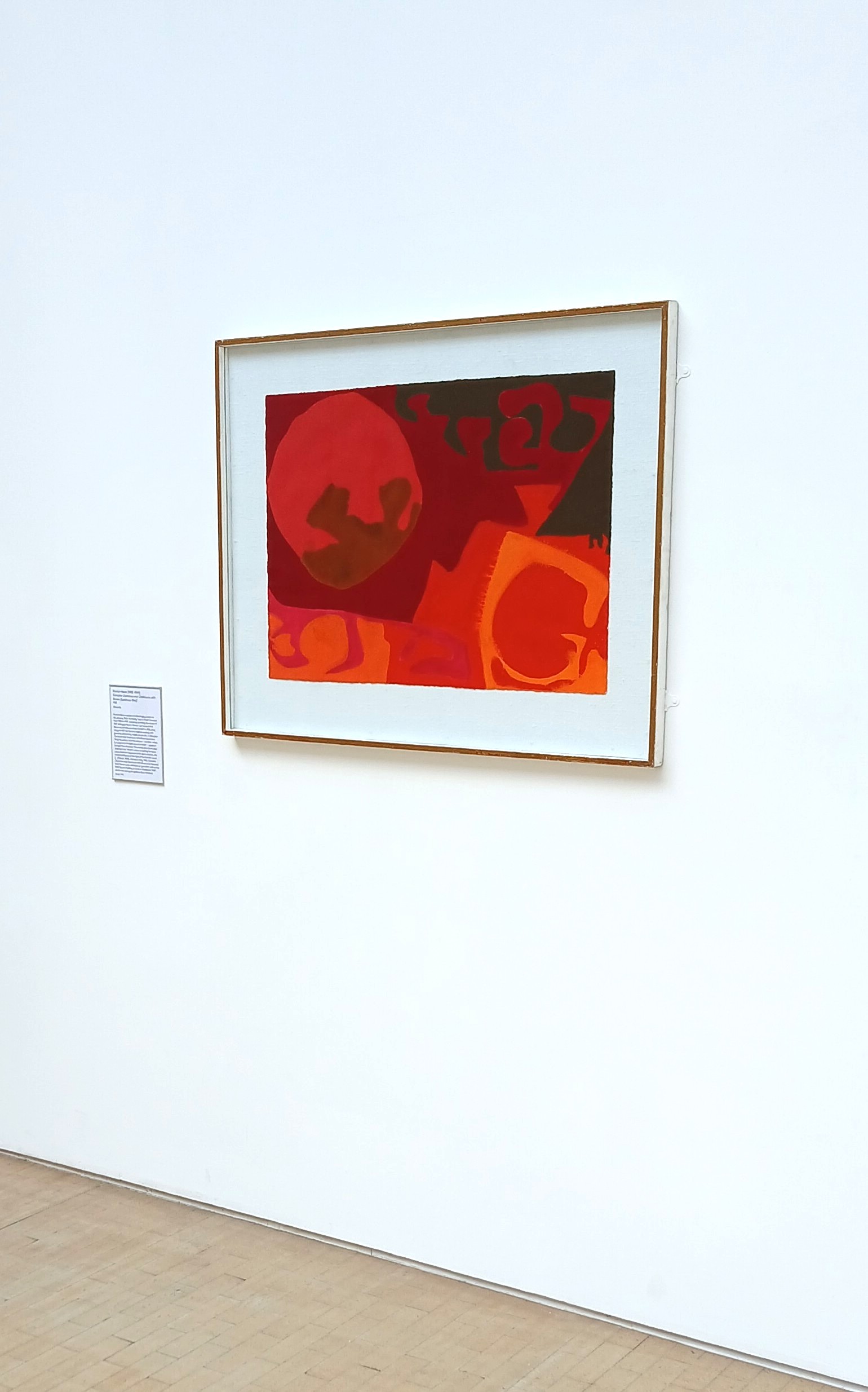
Patrick Heron, Complex Carmines and Cadmiums with Brown (Luminous Disc): May 1968 (1968), Leeds Art Gallery, 56.2 cm x 78.8 cm, gouache on paper.
Patrick Heron was a British modernist painter whose bold, vibrant abstract works drew on his boundless enthusiasm for French modern art – particularly the work of Henri Matisse.[1][2] Born in Leeds, Heron eventually settled in Cornwall, becoming a prominent figure within the St Ives School of artists[1][3] as well as an accomplished writer.[1]
Complex Carmines and Cadmiums is an example of Heron’s highly recognisable ‘wobbly hard-edge’ paintings, completed during the middle years of his career.[4] With their unusual shapes and rich colours, these works are both precise and fluid, recalling the natural rhythms and geography of the coastal surroundings at his home in Zennor.[4][5]
On my most recent visit to Leeds Art Gallery, the fiery, clashing colours of Complex Carmines and Cadmiums were immediately striking. Displayed against a pristine white wall and soaked in copious late spring sunshine from the glass roof above, its colours sang from the paper as if the gouache had just been applied. Such a gushing description is necessary as, in reproduction, much of its radiant glow is lost.
What is discernible in reproduction, however, are the intricate, irregular forms that characterise Heron’s ‘wobbly hard-edge’ paintings. These jagged, straggly, hollowed-out shapes could be said to recall the process of coastal erosion and the complex, precarious rock formations that it creates,[5] although Heron suggested that they can represent protrusions as well as recesses.[4]
Heron’s ‘wobbly hard-edge’ oeuvre includes both oil paintings on canvas and works on paper in gouache,[4] such as Complex Carmines and Cadmiums. In this case, however, the artist’s choice of medium was motivated by practical, rather than artistic, concerns – Heron had broken his leg in a canoeing accident in the summer of 1967 and was disabled for over a year, during which time he was unable to engage in the physical demands of oil painting.[6]
These gouache works undoubtedly have a different effect to the oil paintings – one which is just as ‘wobbly’ but perhaps slightly less ‘hard-edged’, with the water-based medium allowing for slightly less precision and producing some chance imperfections.
Heron, however, was adamant that these works were not subservient to his works on canvas, instead functioning as works in their own right.[7] What was important for Heron was that the opaque nature of gouache allowed for the richness and purity of colour for which his work would become so well-known.[5][4]
[1] Art UK (no date) Patrick Heron. Available at: https://artuk.org/discover/artists/heron-patrick-19201999 (Accessed: 29 June 2025).
[2] Collings, M. (1999) This Is Modern Art. London: Weidenfeld & Nicholson, p. 134.
[3] Tate (no date) St Ives School. Available at: https://www.tate.org.uk/art/art-terms/s/st-ives-school (Accessed: 29 June 2025).
[4] Hazlitt Holland-Hibbert (no date) Patrick Heron: The Colour of Colour. Available at: https://hhh.viewingrooms.com/viewing-room/12/?_preview_uid=175fbea29a544613b725a500b333b5d3 (Accessed: 29 June 2025).
[5] Gayford, M. (2021) Patrick Heron: The Colour of Colour. [Exhibition catalogue]. London: Hazlitt Holland-Hibbert, p. 15.
[6] Gayford, M. (2021), p. 23.
[7] Gayford, M. (2021), p. 60.
 Rethinking the Image
Leave a comment