Image source: https://www.leedsartfund.org/collection/painting-1950 (Accessed: 18 September 2025). © The Estate of Francis Bacon
Francis Bacon, Painting (1950), Leeds Art Gallery, 198 cm x 132 cm, oil on canvas.
As I climb the staircase at Leeds Art Gallery, I look up to the first-floor landing and see a large painting, almost two metres in height, sitting behind glass in a gold frame. Its monochrome central figure, accompanied by an ominous silhouette, leaks out of the unprimed canvas in an unusual pose. This could only be a Francis Bacon painting.
Leeds Art Gallery is understandably proud to have Painting (1950) in its collection, having acquired it shortly after its completion.[1] It sits at the centre of the landing’s main wall under a glass roof, perfectly aligned with the staircase so as to catch the eye of visitors, commanding their attention.
The central figure in Painting is outlined clearly and precisely, allowing details of muscle and flesh to be expressed through sparse, light brushwork. Emerging delicately from the canvas, the figure appears almost transparent, although the vertical stripes of the backdrop are not visible through the body.[2]
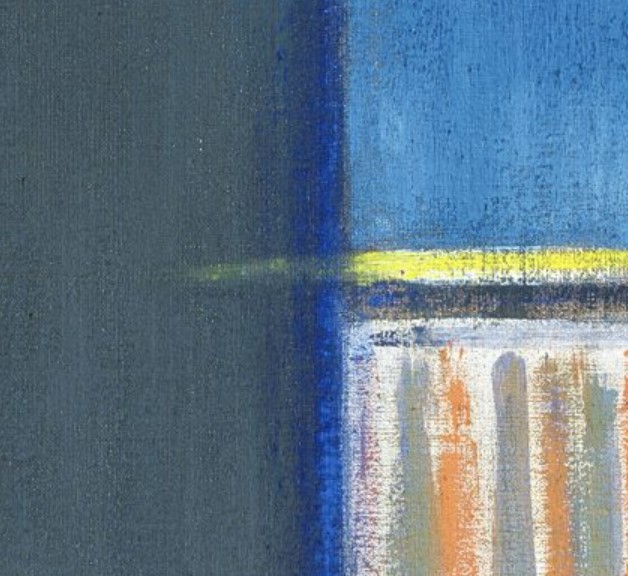
The vertically striped backdrop, in combination with the rail or bar that appears to separate the central figure from the silhouette, suggests a domestic environment. The right hand of the central figure reaches behind the head and over the shoulder, while the drips of paint cascading from the raised elbow resemble a steady stream of water.
It could be said that Painting is somewhat atypical in the context of Francis Bacon’s early career as a painter. Much of his 1950s output is dominated by deep and oppressive hues,[3] whereas Painting employs blocks of primary colour in framing its two figures. In addition, when contrasted with the screaming mouths, tortured grimaces, and writhing bodies that characterise his work during this period, Painting deals less in outright horror and more in subtle, mysterious tension.
[1] Leeds Art Fund (no date) Painting 1950. Available at: https://www.leedsartfund.org/collection/painting-1950/ (Accessed: 18 September 2025).
[2] The vertical stripes seen in Painting are an example of a recurring visual motif in Bacon’s 1950s output. They often create a sense of spatial ambiguity.
[3] Francis Bacon (no date) 1950s. Available at: https://www.francis-bacon.com/artworks/paintings/1950s (Accessed: 18 September 2025).
 Rethinking the Image
Leave a comment